Please ensure Javascript is enabled for purposes of website accessibility
Disclaimer: Yummy Mummy utilizes Google Translate to prepare translations throughout the yummymummystore.com website (the “Website”). The purpose of the translation is to assist non-English speaking/reading customers with understanding the basic content of the site and to facilitate the order of items from the Website. The translation may not be 100% accurate with respect to, but not limited to, tense, tone, or accommodations for specific dialects. If you have any questions about the Website, Yummy Mummy’s offerings, or suggestions or edits to the translation, please contact us at orders@yummymummystore.com or 855-87-YUMMY Descargo de responsabilidad: Yummy Mummy utiliza Google Translate para preparar traducciones en todo el sitio web de yummymummystore.com (el "Sitio web"). El propósito de la traducción es ayudar a los clientes que no hablan inglés / no leen inglés con la comprensión del contenido básico del sitio y para facilitar el orden de los artículos del sitio web. La traducción puede no ser 100% precisa con respecto a, pero no limitado a, tiempo, tono, o adaptaciones para dialectos específicos. Si tiene alguna pregunta sobre el sitio web, las ofertas de Yummy Mummy o sugerencias o ediciones de la traducción, comuníquese con nosotros al correo electronico orders@yummymummystore.com o 855-87-YUMMY

Amanda Cole

Why Do I Need a Breast Pump?

Why Do I Need a Breast Pump?

Congratulations on your new love, and your decision to breastfeed. Breast feeding is a wise choice when considering finances, convenience, and the health of your baby. Your breast milk is always available and at the perfect temperature. The bond created between mother and baby while nursing is irreplaceable. As beautiful and convenient as breastfeeding is, it can also be draining, sometimes frustrating, and inconvenient at certain times, such as when mom must work or needs some rest. Having a reliable breast pump on hand can ease your worry about those possible situations.


How a Breast Pump Works

A breast pump works by mimicking your baby’s suckling action. As your baby nurses, your body responds to their suckling pattern, and makes more milk accordingly. Pretty Amazing! When a breast pump is used properly, you can fool your breast into thinking the baby is nursing. The result is a letdown, and the milk begins to flow. The milk can just be dumped if you are pumping for relief, bottled for immediate consumption, or refrigerated or frozen for future use.


A Breast Pump May Be Helpful to You

As a new or an experienced nursing mother, you are probably finding out that you love breastfeeding, but there are times when you’d like to be able to have someone else enjoy feeding time, you need to run some errands or maybe you just want to meet a friend for lunch. If that is that is the case, you will need a breast pump so that you can pump and store your milk to give to your baby when you are away.

If you are planning to go back to work, you will likely need a double electric breast pump because having a supply of extra breastmilk on hand will be necessary while baby is in someone else’s care for hours at a time. Make sure that you familiarize yourself with the pump and its accessories before returning to work. You will need to build up a few days supply of milk, but you don’t need to worry about storing large amounts. You will be bringing home fresh milk every day.

There can also be situations where your baby goes on a hunger strike, and chooses to suddenly sleep more than they were, and eat less. This can cause your breasts to become engorged as they continue making the amount of milk baby was previously needing. Don’t panic, as this is a natural occurrence. During this adjustment period, a pump can help give you some relief.

No matter the reason, as a breastfeeding mother, having a reliable breast pump is a helpful tool when necessary. Don’t get caught off guard in the middle of the night, realizing a pump would suddenly be “oh so helpful!” Just like all your baby equipment and essentials, it is best to have your breast pump ordered even before the baby comes into this world. Most insurance plans will cover a double electric breast pump at no cost to mom, and you can order it months before your baby arrives. The only catch is that some insurers won’t allow the pump to ship to you until 30 days before your due date or even after the baby is born.


Which one is the Best Breast Pump?

Choosing the best breast pump for you can be tricky, and often depends on your personal needs. Do you plan to travel and need something lightweight? Do you want a super quiet motor so as not to disturb your partner in the middle of the night? There are several great options out there and it all depends on what you are looking for.

Yummy Mummy is proud offer only the top rated breast pumps the Medela Pump In Style and the Medela Freestyle Flex Breast Pump, the S1 & S2 Spectra Breast Pumps, the Ameda Mya and Mya Joy Breast Pumps, the Evenflo Double Electric Breast Pump with Hush Motor, the Lansinoh SignaturePro and Smartpump Breast Pumps, and the Hygeia Enjoye Breast Pump.


An Advantage of a Free Breast Pump by Utilizing Insurance Options

An Advantage of a Free Breast Pump by Utilizing Insurance Options

If you are a new mom, or you are expecting, you already know that the prices for anything related to your new bundle of joy can be more than expected. After the crib, the changing table, the rocker, high chair and stroller, it is difficult to budget for baby costs. Did you know that in many cases, you’re able to get a breast pump through insurance? If you didn’t know that you might be able to get an insurance breast pump at no out-of-pocket cost to you, we have important information for you!


Why Breastfeeding Is So Important

The American Academy of Pediatrics says that if possible, mothers should breastfeed their children for at least one year after birth. Studies have shown that breast milk is the best way to feed your baby. Your breast milk contains antibodies against disease, which will protect your baby through the first few months of his or her life. In addition, breastfeeding cuts the chances that your baby might have an allergic reaction to formula. There are also studies that indicate breastfeeding may help children with a genetic predisposition to allergies and asthma. Clearly, if you can breastfeed, you should consider it!


Getting A Breast Pump Through Insurance

Depending on your insurance company, you may qualify for a breast pump at no charge to you. The Affordable Care Act states that your insurance company must cover the costs of the breast pump. While a few plans have been “grandfathered in” and don’t cover the benefit, the overwhelming majority do. So, check with your insurance plan to see if they will cover a breast pump.


What Will My Insurance Cover?

Most insurance providers will cover a double electric breast pump and/or a rental pump if there is a medical necessity. Most will limit you to one breast pump per pregnancy, or one breast pump every few years. Ask your insurance company what they will cover. Most insurance companies will only cover the cost of a breast pump if you order it through an in-network Durable Medical Equipment Provider. If your insurance plan is in-network with Yummy Mummy, you are in luck. You can order your breast pump in three easy steps and we will ship it to your door.

Do you have questions? Please email us at orders@yummymummystore.com" orders@yummymummystore.com or call 855-87-YUMMY.

Bravado Limited Edition Nursing Tank NYC Retailer

It's such an honor to be the only retailer in NYC to carry Bravado Designs Limited Edition Essential Nursing Tank designed by celebrity designer Rebecca Minkoff. 20% of all sales will be donated to Jessica Seinfeld's charity Baby Buggy, dedicated to providing families in need across the US.

Breastfeeding Week Spotlights US Maternity Policies (Forbes)

Breastfeeding moms in the US have much to celebrate during this year’s World Breastfeeding week. Women pregnant when the US Department of Labor passed last year’s “Break Time for Nursing Mother’s” provision can now take full advantage of the law which requires employers to provide both a reasonable break time and place for employees to pump or otherwise express breast milk. In addition, a 2011 ruling by the IRS enables breastfeeding families to use pretax money from their flexible spending accounts to purchase pumps and other breastfeeding supplies.

Furthermore, good news has been released regarding the benefits of breastfeeding for both mom and baby. Results from a study by the University of Pittsburgh’s Department of Medicine show that breastfeeding may lower a mother’s risk of Type 2 Diabetes. And in a review of 288 studies on breastfeeding and Sudden Infant Death Syndrome (SIDS) data, researchers conclude in July’s issue of Pediatrics that breastfeeding protects against SIDS.

For today’s moms, unlike past generations, breastfeeding is widely encouraged by both physicians and the media alike. Celebrities are frequently heard boasting about the many reasons they love nursing (weight loss! bonding! ease of use!) and some even pose for photos with baby at breast. Indeed breastfeeding is very much in vogue. And with Michelle Obama incorporating it into her campaign to reduce childhood obesity, it has seldom been as topical.

Breastfeeding is such a positive experience for most of the nursing moms at Yummy Mummy, the breastfeeding store I own and run, that many of my moms are unable to fight back tears when they think about their inevitable return to work and the prospect of pumping for their baby rather than breastfeeding. Pumping at works enables mothers to breastfeed for as long they wish even though they are separated from their baby. And many of my moms pump and breastfeed or exclusively pump very successfully. But pumping at work requires dedication. It also takes time and coordination that some working mothers feel is hard to find.

It is no secret that maternity leave durations in the US are much shorter than others around the world. In the US, the average mother is permitted just six weeks of time off and, because most often the time off is unpaid, many moms can’t afford to take any leave at all. Compare this to the subsidized 4 years both moms and dads can enjoy in the Czech Republic and the 16 months both parents are entitled to in Sweden.

In a new study by Pediatrics, researchers found that less than 65% of women who took shorter maternity leaves (one to six weeks) tried breastfeeding while close to 75% of women with longer maternity leaves (around 13 weeks) attempted to breastfeed. Countries with longer maternity leave practices, like Sweden, enjoy some of the highest breastfeeding rates in the world with initiation rates in Sweden close to 100%. Unfortunately, many mothers in the US are giving up before even trying.

The Center for Disease Control’s (CDC) breastfeeding objectives published in its Healthy People 2020 include increasing the percentage of mothers who breastfeed at six months and mothers who breastfeed exclusively at six months as well as reducing formula supplementation at birth and enhancing lactation support within hospitals and the workplace.

As important as the CDC’s guidelines are, for improved breastfeeding participation, especially among working moms, it will be difficult for the US to meet these goals without a new and enlightened maternity leave policy. Quite simply, the US’ six-week maternity leave is no formula for increasing breastfeeding norms to 6 months.

Pampering for Nursing Mothers in the New York Times

image

By Jessica Grose

Underneath Yummy Mummy’s cheerful purple awning on Lexington Avenue between 81st and 82nd Streets, a mannequin wearing a Boob brand striped nursing top has one breast peeking out. The cheeky tableau announces the shop’s mission as clearly as the slogan stenciled on the door: “Happy breastfeeding.”

image

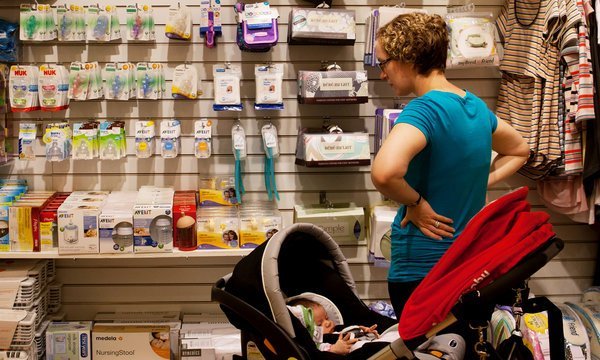
Equal parts upscale boutique and Duane Reade, the bright, well-organized space offers new and expectant mothers practical nursing necessities and a little necessary pampering for their breasts. And with products like Nummies brand nursing bras, goat’s rue herbal supplements (to increase breast milk production) and Earth Mama nipple butter, it can be hard to tell which is which.

The store’s pumps, mostly made by Medela, camouflage their medical-equipment origins in smooth molded plastic and rubber-duckie yellow. A “pump in style” rig — if a backpack counts as stylish on the Upper East Side — runs the new mother $299; the “freestyle,” which clips onto her belt like an engorged BlackBerry, costs $379. Hospital-grade pumps are available for rental, as well.

On a recent early Thursday afternoon, a woman sat on a plush couch in the back to nurse her infant daughter while early Michael Jackson played in the background. She had just bought some nipple shields — small pieces of silicone that can make breast-feeding easier for infants. The store’s owner, Amanda Cole, lent her a hot-pink patterned pillow to strap around her waist to support the baby. Soon, her daughter was happily sucking away, and the woman was chatting with Ms. Cole about how her older son was adjusting to the new addition to the family.

In the Manhattan work-life ballet, doing what comes naturally can get pretty complicated. So when Ms. Cole, 36, opened the store in 2009, the idea was to offer nursing mothers both products and instruction: breast-feeding classes, prenatal yoga and events like “doula speed dating,” in which expectant parents can meet and choose a labor coach.

“When I first had to use my breast pump,” Ms. Cole recalled, “I called my sister, who luckily lived across the street, and I was like, ‘Get over here, I have no idea what to do, this apparatus is so scary.’ ”

The shop serves local professionals and stay-at-home moms and receives a steady stream of business from women visiting obstetricians affiliated with Lenox Hill Hospital nearby. On this Thursday, one woman arrived with her husband and baby in tow. The man stood uncomfortably amid the maternal miscellany while the woman tried on a series of nursing-friendly nightgowns in blue and black.

“They always feel like they’re the first dad that’s ever come in here,” Ms. Cole observed.

By 6 p.m., most of the shoppers had drifted out, and the women attending the evening’s prenatal breast-feeding class started to trickle in. Wendy Schwartz, who lives on the Upper West Side, was expecting her second child in two weeks and had come for a refresher. “We didn’t think we’d have another,” she said. “So we threw everything out and forgot everything.”

The class’s teacher, Kate Sharp, has been a lactation consultant for 24 years, and she projected a tidy and confident air. She wore very sensible shoes.

She put in a DVD, and the screen displayed a newborn scooting toward her mother’s breast without any help. Ms. Sharp turned off the sound (“goofy childbirth music,” she sniffed), but told the class to watch how the baby instinctively made her way to the food source.

Ms. Sharp had a baby doll dressed in a red onesie that she used to show the class proper positioning. She leaned back against her chair with the doll propped against her chest to show how easily a baby could be supported.

“Just do this,” she said, offering advice as old as motherhood itself, “and you’ll feel like a magician.”

See the article on the New York Times website…

Milk Blisters

Boob Scoop

If you've ever had a milk blister on your nipple, you most likely remember how painful one can be. Like a paper cut, it makes you wonder how something so small could hurt so much! Improper latching and an oversupply are the most common causes of milk blisters. Here's a helpful overview on what they are and ways to treat them: http://kellymom.com/bf/concerns/mother/nipplebleb/

Milk storage capacity is not determined by breast size

Boob Scoop

Breast storage capacity refers to how much breastmilk a mother can hold in her breasts in between feedings. Storage capacity is not determined by breast size, although breast size can certainly limit the amount of milk that can be stored. A mother with a larger milk storage capacity may be able to go longer between feedings, without impacting milk supply and her baby’s growth. A mother with a smaller storage capacity, however, may need to nurse her baby more often to satisfy her baby’s appetite and maintain milk supply, since her breasts will become full quicker. In the end, either capacity can allow a mother to produce enough breastmilk for her baby.

Simple is Best for Mothering Advice

Boob Scoop

Concise and practical information is usually all mothers need to get breastfeeding off to a good start. You'll be happy to have read this excellent piece if you're due soon. http://fullbellysisters.blogspot.com/2011/08/five-things-you-can-do-during-your.html

Sharen Medrano, Yummy Mummy Support Group IBCLC (www.nycbreastfeeding.com)